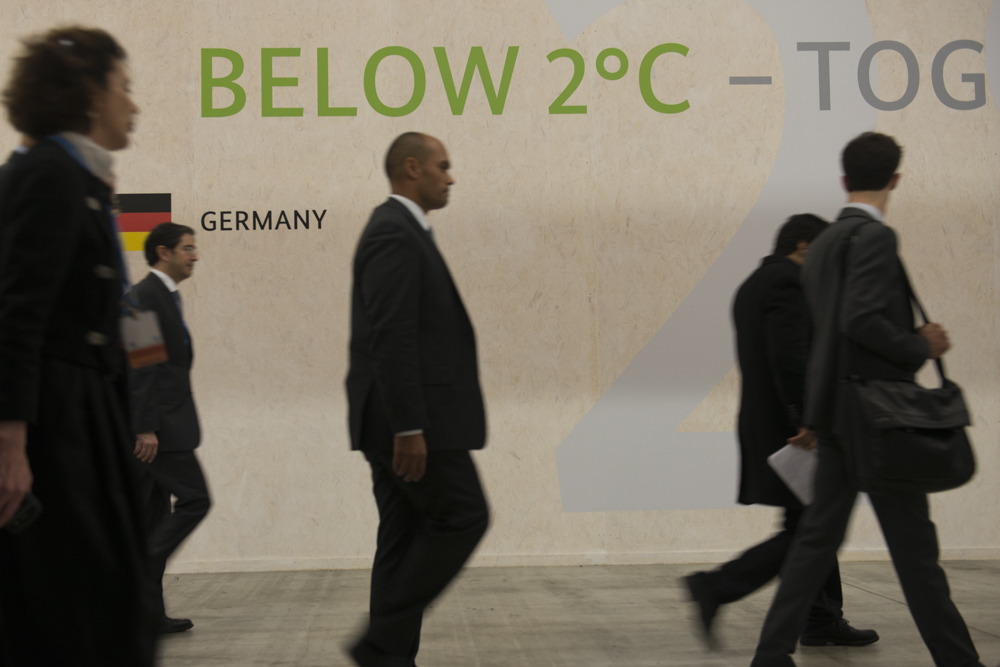
November 30, 2015 – Paris, France: The first day of the two week conference in Paris in which 185 countries come together to decide how to tackle the challenge of climate change. The conference includes world leaders, scientists, lobbyists and representatives from businesses, industry, and agriculture along with environmental groups culminating to the staggering number of 40,000 people. (Joao Luiz Bulcao/Polaris)
At COP21 the feeling is definitively motivation. During the first two days, in the blue zone, negotiators and observers (civil society) seem convinced of the need of a universal agreement to hold the increase of global average temperature below 2°C. It is rumored in the corridors inside the UN space dedicated, the so-called “blue zone”. National delegations do want to act for the common good.
This new planetary awareness is taking place at the conference, in contrast of what was going on during the Copenhagen Conference in 2009. Back to this time, the awareness of a common danger was not so acute. Six years later, climatic tragic disorders have become a true reality, as they are from now on under the glare of the media, what strikes public opinion. Philippa Rowland, Australian citizen and member of both the ONG Catholic Earthcare and National Energy Efficiency Network notes that is new at COP21, coming here as a simple observer. She was already in Copenhagen. Many observers think that national public opinion, especially Chinese and African, have brought about changes in negotiators ‘positions. They have a mandate to reach an effective agreement. Otherwise they may be disallowed.
But what will this agreement be like at the end? What understandable decisions should be written down? What finance and assessment tools could be implemented that would satisfy all “Parties”, just enough to take care of the poorest, no matter if they live in developing countries or developed countries. Insurance companies get worried and businessmen as well. Sure, this has the advantage of getting things moved forward. The answer in 10 days.